
Insulation That Stops Air Movement Completely
Spray Foam Insulation in Erath for homes and buildings losing conditioned air through gaps in walls, attics, and crawl spaces
Acadiana Custom Coatings LLC installs spray foam insulation throughout Erath and surrounding areas for residential and commercial properties where air leakage undermines heating and cooling efficiency. You need this service when your energy bills remain high despite running HVAC systems constantly, when certain rooms feel uncomfortable regardless of thermostat settings, or when you notice dust accumulation that suggests outside air is entering the building envelope. Spray foam creates a continuous air barrier that traditional insulation materials cannot achieve because it expands into every crack and gap during application.
The service addresses thermal loss and air infiltration by applying foam that expands to seal penetrations around wiring, plumbing, framing joints, and other areas where fiberglass batts or blown material would leave gaps. Louisiana's humidity makes moisture control critical, and spray foam's air-sealing properties prevent warm, moist outdoor air from reaching cooler interior surfaces where condensation forms. The foam adheres directly to wood, metal, concrete, and other substrates, creating a sealed building envelope that reduces the workload on cooling equipment.
Schedule a property assessment to identify where air leakage is affecting your building's performance.
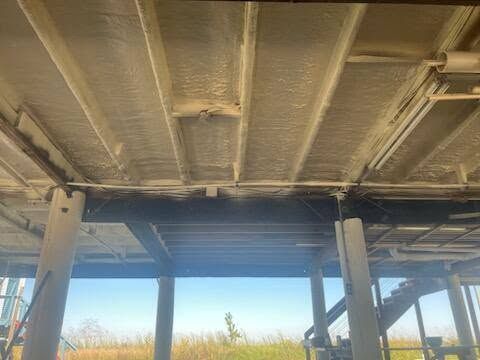
How Spray Foam Changes Building Performance
The application process fills cavities in attics, walls, crawl spaces, garages, metal buildings, and warehouses with expanding foam that cures into a solid insulating layer. You decide between open-cell and closed-cell formulations based on whether the space requires vapor control, structural reinforcement, or maximum R-value per inch, with each type suited to different parts of the building envelope and performance requirements.
After installation, you notice immediate differences in how the building feels—temperature becomes consistent from room to room, drafts around outlets and baseboards disappear, and HVAC systems cycle less frequently because conditioned air stays inside the envelope. The foam remains stable for decades without settling or developing gaps, unlike batt insulation that can compress or shift over time, which means the thermal performance and air sealing continue without degradation.
The service works for new construction where the building envelope is being established and for existing structures where insulation upgrades address performance problems. Metal buildings benefit particularly from spray foam because it prevents condensation on interior metal surfaces and adds rigidity to wall and roof panels, while residential attics gain both thermal resistance and air sealing that reduces the load on ductwork running through unconditioned space.
What Owners Ask About Foam Insulation
Property owners throughout the region typically want to understand how spray foam compares to traditional materials and what results they can expect from the investment.
What makes spray foam more effective than fiberglass batts or blown insulation?
Spray foam eliminates air movement through the building envelope by sealing every gap and penetration during application, while fibrous insulation only slows heat transfer without stopping airflow that carries both thermal energy and moisture into wall and attic cavities.
How does spray foam help with moisture problems in Louisiana buildings?
The air sealing prevents humid outdoor air from infiltrating into cooler interior spaces where condensation would form, which is critical in Erath's climate where high humidity combines with air-conditioned interiors to create conditions for mold growth and wood rot in unsealed building assemblies.
What areas of a building benefit most from spray foam application?
Attics show the greatest impact because they experience extreme temperature differences and contain the most air leakage points around penetrations, but crawl spaces, exterior walls, and metal building envelopes also gain significant performance improvements from the continuous air barrier.
How much can spray foam reduce heating and cooling costs?
Energy savings depend on how much air leakage existed before insulation, but buildings with significant gaps around framing, ductwork, and penetrations typically see 30 to 50 percent reductions in conditioning costs once the envelope is sealed and properly insulated.
Does spray foam require different installation methods for residential versus commercial projects?
The application equipment and technique remain consistent, but commercial projects like warehouses and metal buildings often require closed-cell foam for structural benefits and moisture resistance, while residential attics may use open-cell foam where vapor control is less critical and coverage area matters more than density.
Acadiana Custom Coatings LLC provides free insulation assessments that identify where air leakage is occurring and what foam type will address your specific building conditions. Request an evaluation to determine how spray foam will improve your property's energy performance and indoor comfort.